
What is GEO?
We’ve all felt it. You open Google, type a question, and before you can even look at the “blue links,” a sleek AI window has already answered you.
For two decades, the goal of the internet was simple: SEO (Search Engine Optimization). You used keywords, built backlinks, and hoped for a click. But in 2026, the game has fundamentally changed. We are no longer just optimizing for a search engine; we are optimizing for a Generative Engine.
This is GEO. And if you want your website to survive the next five years, you need to understand exactly how it works.
What Exactly is GEO?
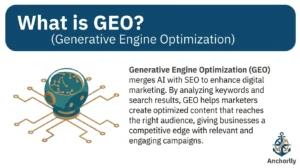
Generative Engine Optimization (GEO) is the process of making your content so clear, authoritative, and well-structured that Artificial Intelligence models (like Google Gemini, ChatGPT, and Perplexity) choose your site as their primary source.
In the old days of SEO, you wanted to be #1 on a list.
In the new era of GEO, you want to be the answer the AI speaks.
Think of it this way: SEO gets you onto the library shelf. GEO makes you the person the librarian quotes when someone walks in and asks a question.
Why Does GEO Matter Right Now?
If you’ve noticed your website traffic fluctuating recently, you’re not alone. Recent 2026 data shows that “Zero-Click Searches” have spiked. Over 60% of searches now end on the Google results page because the AI provided the answer directly.
Why should you care?
- Brand Authority: When an AI says, “According to [Your Brand], the best way to…”, it builds more trust than a simple search link ever could.
- Higher Quality Traffic: While total clicks might be down, the people who do click through from an AI citation are 4x more likely to convert. They already trust you because the AI “vetted” you.
- Future-Proofing: Traditional search volume is predicted to drop by 25% by the end of 2026. GEO is how you capture the traffic that is moving to AI assistants.
SEO vs. GEO: What’s the Real Difference?
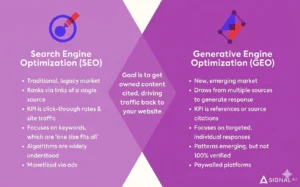
It’s easy to get confused, so let’s look at them side-by-side.
| Feature | Traditional SEO | Generative Engine Optimization (GEO) |
| Primary Goal | Rank in the top 3 positions. | Be cited/linked in an AI summary. |
| Core Target | Search algorithms (Googlebot). | Large Language Models (LLMs). |
| How Users Find You | They browse a list and click. | They read a generated answer. |
| Success Metric | Clicks and Bounce Rate. | Citation Share and “Share of Voice.” |
| Trust Signal | Backlinks and Keywords. | Unique Data, Stats, and Mentions. |
The 4 Technical Pillars of GEO
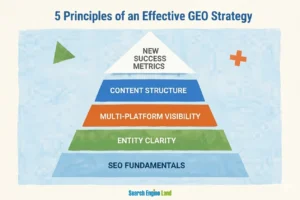
To rank in 2026, your content needs to be “digestible” for a machine. This isn’t just about keywords; it’s about Information Architecture.
Pillar 1: Semantic Connectivity
AI doesn’t just look for words; it looks for concepts. If you’re writing about “What is GEO,” the AI expects you to also talk about RAG (Retrieval-Augmented Generation), LLMs, and Search Intent.
Strategy: Build “Topic Clusters.” Don’t write one-off posts. Create a web of content that proves you are a “Topical Authority” on the subject.
Pillar 2: Information Extraction Density
AI models have a “context window”—a limit on how much they can read. If your writing is 50% “filler” and “marketing fluff,” the AI will miss your important points.
Strategy: Every sentence must provide value. Aim for high fact-density. Instead of saying “Many people think GEO is cool,” say “A 2026 study found that GEO can increase AI visibility by 40%.”
Pillar 3: Entity Relationships
The AI sees your brand as an Entity. It checks the rest of the web to see who you “hang out” with.
Strategy: If your brand is mentioned on Reddit, YouTube, Wikipedia, or major news sites, the AI builds a “Knowledge Graph” around you. It trusts you more because other trusted sources mention you.
Pillar 4: Structured Signal Clarification
AI is smart, but it loves a shortcut. Schema Markup (JSON-LD) is a hidden language that tells the AI exactly what your content is.
Strategy: Use FAQ Schema, Author Schema, and Review Schema. It’s like labeling the boxes in a warehouse so the AI can find the “good stuff” instantly.
Mastering E-E-A-T in the Age of AI
Google’s E-E-A-T (Experience, Expertise, Authoritativeness, and Trustworthiness) guidelines are more important in 2026 than they were five years ago. Because AI can generate “generic” content, Google rewards content that feels lived-in.
Experience
Don’t just explain what GEO is. Share a case study.
Use phrases like, “In our testing…” or “What we found when we implemented GEO for a client was…” AI cannot replicate real-world experience.
Expertise
Who wrote this? AI search engines prioritize content with a clear author.
Every article needs an author bio. Link to your LinkedIn, your awards, and your previous work. Show the AI you aren’t just a generic blog.
Authoritativeness
This is about your reputation.
Get mentioned on platforms like Reddit or Quora. When humans discuss your expertise on social platforms, AI engines “listen” and give you more weight in their answers.
Trustworthiness
Cite your sources!
If you state a fact, link to the study. A page with zero external links is a huge red flag for an AI engine in 2026.
The 5-Step Strategy to Rank for “What is GEO”
If you want this exact article to rank on Page 1 and get cited by Gemini, follow this checklist:
The “AI-Ready” Summary
Start your article with a 50-75 word summary. Put it in a box or a blockquote. This is the “bait” for the AI to grab and use as its opening sentence.
Use “Question-Style” Headers
People ask AI questions. Use your H2s to reflect those questions.
Example: Use “How does GEO differ from traditional SEO?” instead of just “SEO vs GEO.”
Write in “Snackable” Blocks
AI doesn’t always read your whole article. It “clips” parts.
Strategy: Ensure every paragraph can stand on its own. If you’re defining a term, do it in one clear, self-contained paragraph.
Include Original Data
AI is trained on old data. It craves new data.
Strategy: Run a poll on LinkedIn or survey your readers. If you provide a unique stat like “82% of SEOs are worried about GEO in 2026,” the AI will scramble to cite you as the source of that new information.
Optimize for “Fan-Out” Queries
When someone asks a complex question, the AI breaks it into smaller “sub-queries.”
Strategy: Make sure your article answers the “side questions” too. For example, explain the technical side (RAG) and the business side (ROI) in the same post.
Common Myths About GEO
False. SEO is the foundation. If the AI can’t find your site through traditional search crawling, it can’t cite you. GEO is simply SEO 2.0.
“Longer is always better.”
False. AI prefers clarity over length. In 2026, a 1,000-word article with 10 amazing facts beats a 3,000-word article with 0 facts every single time.
“AI content automatically fails E-E-A-T.”
False. Using AI to help you outline or research is fine. But if you don’t add human experience and original insights, the AI won’t bother citing it because it already has that “generic” information.
The Future of Search
As we move through 2026 and into 2027, the line between “the web” and “the AI” will disappear. We are moving toward Conversational Commerce. Users won’t just ask “What is GEO?” They will ask, “Can you find me a consultant who can fix my GEO strategy by Friday?”
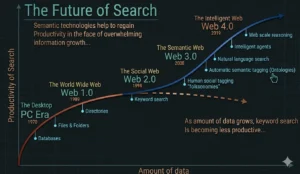
To win in that world, you need to stop being a “link” and start being an authority. ### Final Checklist for Your Blog:
- [ ] Is the “Answer” in the first paragraph?
- [ ] Do I have clear H2/H3 question headers?
- [ ] Have I used Schema.org structured data?
- [ ] Is there an expert author bio attached?
- [ ] Did I include original photos or data?