
What Are Keyword Match Types?
Before comparing broad and phrase match, first understand what keyword match types are.
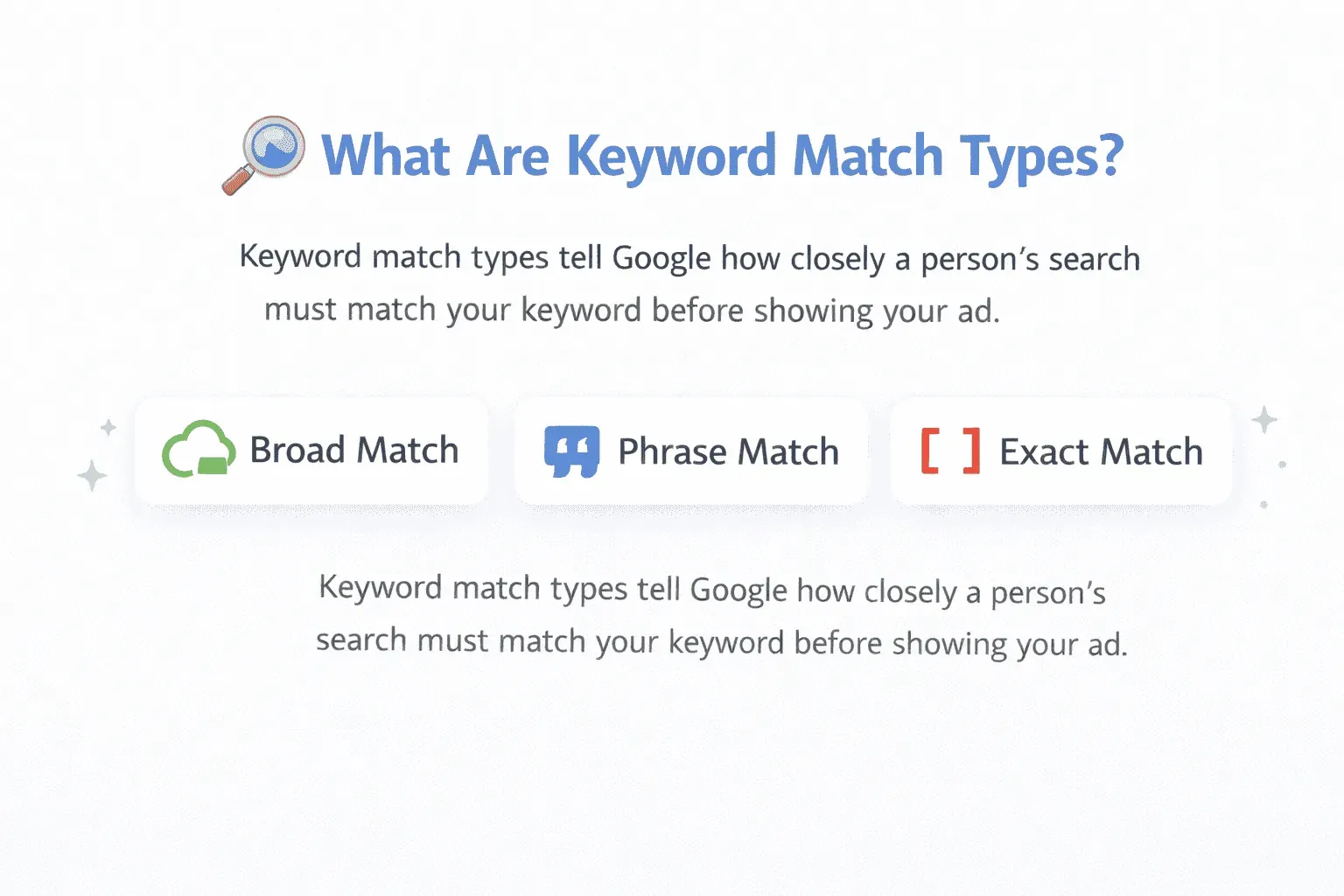
Keyword match types tell Google:
How closely a person’s search must match your keyword before showing your ad.
Simply put, match types determine when you are going to show your ad.
Unless you select the appropriate match type, you are likely to display your ad to the wrong individuals. That means a wasted budget.
There are three match types in Google Ads:
- Broad Match
- Phrase Match
- Exact Match
We concentrate on the broad vs. phrase match in this article.
What Is Broad Match?
The default match type of keyword in Google Ads is Broad Match.
Once you add a keyword that has no symbols, Google automatically applies Broad Match.
Example:
- Keyword:
digital marketing course - Under Broad Match, your advertisement may appear:
- online marketing classes
- SEO course
- social media training
- marketing certification
- internet marketing lessons
Although these specific words are not in the search, it is possible that Google will display your advertisement anyway.
How Broad Match Works
Broad Match employs a smart system (AI) of Google. It looks at:
Similar meaning words
- Related topics
- User intent
- Synonyms
Google attempts to know what the user desires.
For example:
If someone searches:
How to study online marketing.
Your advertisement about the course of digital marketing can be seen.
That is a broad match.
Advantages of Broad Match
Here are the benefits:
1. More Traffic
Broad match has high impressions and clicks.
2. Finds New Keywords
It can assist you in finding out other search words you have never considered.
3. Good for New Campaigns
Broad match assists in data gathering in case you are beginning with it.
4. Smart Bidding Works Well.
The more data it has, the better Google’s AI can perform.
Flaws of Broad Match.
Broad Match also has risks.
1. Less Control
Google determines the timing of your advertisement.
2. Irrelevant Traffic
Your advertisement might appear on a search that is not related to your business.
3. Budget Waste
You can even pay a price on clicks not converting.
Example:
In the case of paid courses, your advertisement will appear:
free marketing course
That click is useless.
What Is Phrase Match?
Phrase Match is more controllable than Broad Match.
In order to employ Phrase Match, you enter your keyword with quotation marks on either side.
Example:
“digital marketing course”
Your advertisement will now appear when that phrase or a similar meaning is searched using Google.
How Phrase Match Works
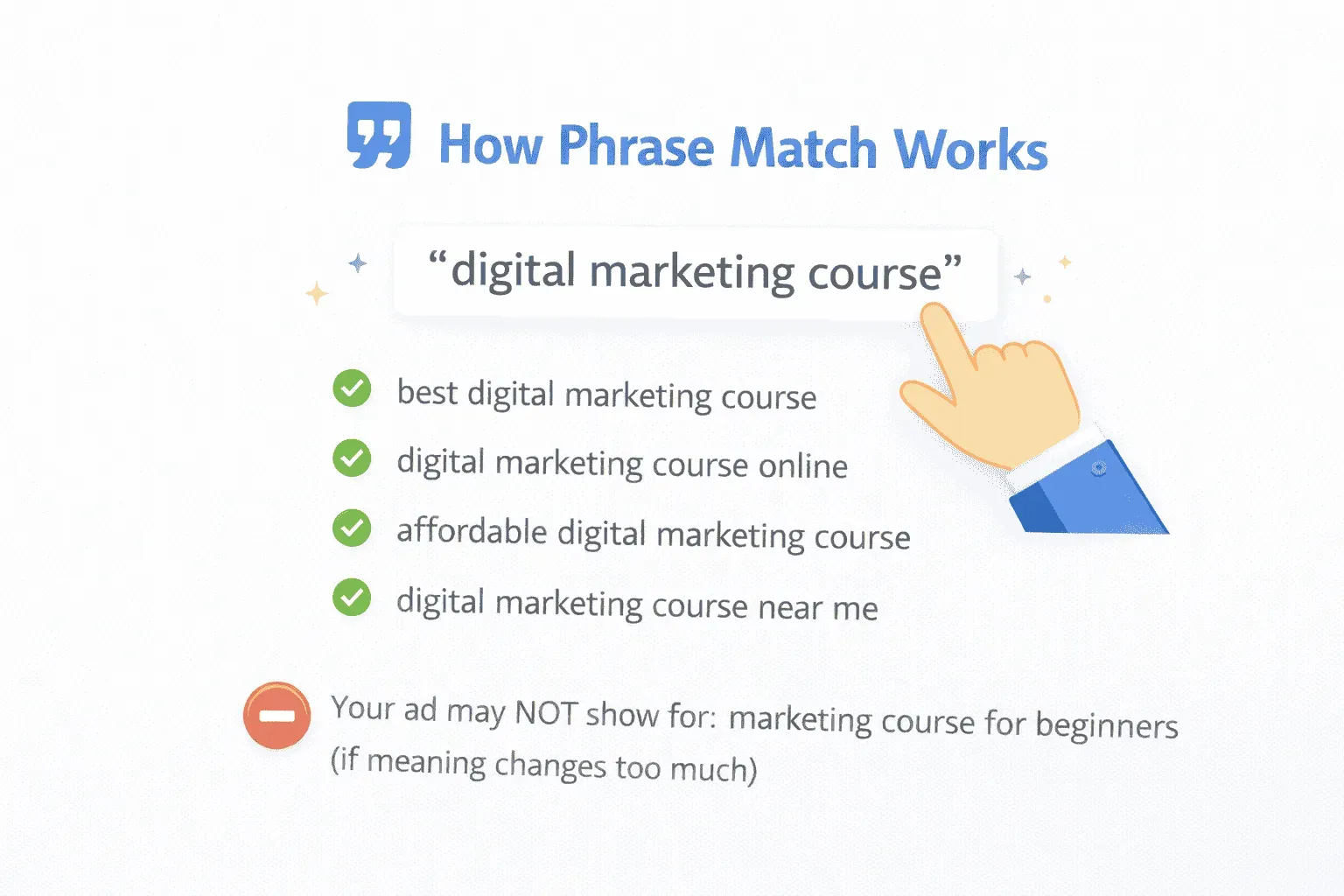
Phrase Match keeps the meaning of the keyword the same.
Your ad may show for:
-
best digital marketing course
-
digital marketing course online
-
affordable digital marketing course
-
digital marketing course near me
But it may NOT show for:
-
marketing classes for beginners
(if the meaning is too different)
Phrase Match focuses more on relevance.
Advantages of Phrase Match
1. Better Targeting
Increased users are more relevant to your ad.
2. Higher Conversion Rate
Traffic is more qualified.
3. Less Budget Waste
Fewer irrelevant clicks.
4. Balanced Reach
Not too wide, not too narrow.
Negatives of Phrase Match.
1. Lower Traffic
Compared to Broad Match.
2. Slower Keyword Discovery
You are likely to miss certain search opportunities.
Broad Match vs Phrase Match: Simple Comparison
Let’s compare them clearly.
| Feature | Broad Match | Phrase Match |
|---|---|---|
| Traffic | Very High | Medium |
| Control | Low | Medium |
| Relevance | Mixed | Higher |
| Budget Risk | High | Lower |
| Conversion Rate | Lower | Higher |
| Best For | Testing & Scaling | Targeted Campaigns |
Real-Life Example
Let’s say you sell running shoes.
Broad Match Keyword:
running shoes
Your ad may show for:
-
sports shoes
-
jogging sneakers
-
marathon gear
-
gym shoes
-
athletic equipment
Some searches may not be related to buying.
Phrase Match Keyword:
“running shoes”
Your ad may show for:
-
Buy running shoes
-
best running shoes for men
-
running shoes near me
-
cheap running shoes
These users are clearly looking for running shoes.
So Phrase Match brings more targeted traffic.
Which One Brings More Sales?
Broad match is more traffic-generating.
Phrase match generates more traffic.
Increased traffic does not necessarily increase sales.
Phrase Match tends to work better in case you want conversions and profit.
In Which Cases Should You Use a Broad Match?
Use Broad Match when:
- You are testing a new product
- You would like to find out new keywords.
- You have a large budget
- You use Smart Bidding
- You want fast growth
Always use negative keywords with full match, though.
What Are Some of the Times You Are Supposed to use Phrase Match?
Use Phrase Match when:
- You want better control
- You want quality leads
- You want stable results
- You want better ROI
- You are streamlining campaigns.
- Phrase Match is less risky when limited in budget.
- The relevance of negative keywords.
Negative keywords prevent unnecessary adverts of unnecessary searches.
Example:
- If you sell paid courses, add:
- free
- jobs
- cheap
- This prevents waste.
Broad match is very important with regard to negative keywords.
Best Strategy for Maximum Results
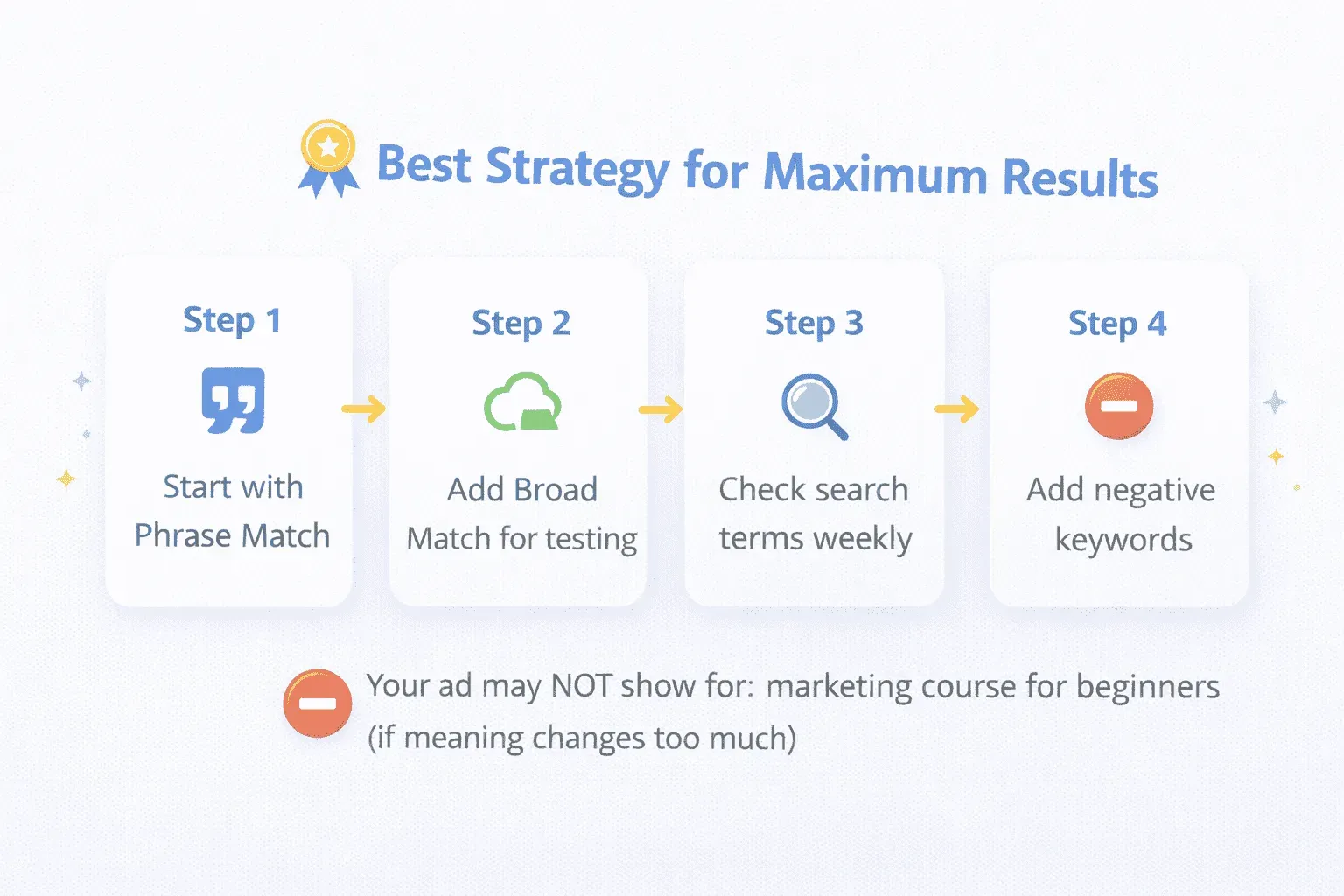
Instead of choosing only one, use both smartly.
Smart Strategy:
Step 1: Start with Phrase Match
Step 2: Add broad match to test.
Step 3: Check search terms once a week.
Step 4: Add negative keywords
Step 5: Migrate good-performing keywords to phrase match.
This gives balance.
Common Mistakes to Avoid
❌ Using Only Broad Match Without Monitoring
This wastes money.
❌ Ignoring Search Term Reports
Always check what people actually search.
❌ Not Tracking Conversions
Without tracking, you cannot optimize.
❌ Mixing Everything Without Strategy
Always test properly.
Which One Is Better for Beginners?
For beginners, Phrase Match is better because:
-
It gives more control
-
It reduces waste
-
It brings better-quality traffic
After gaining experience, you can test Broad Match.
Which One Is Better for Experts?
Experts often use both.
They:
-
Use Broad Match with Smart Bidding
-
Use Phrase Match for high-performing keywords
-
Continuously optimize
How Google AI Changed Broad Match
In the past, broad match was risky.
Today, Google’s AI is smarter.
But it still needs:
-
Good conversion tracking
-
Smart bidding
-
Strong negative keyword list
Without these, Broad Match can still waste money.
Conclusion
Finally, the broad match and phrase match are significant in an effective Google Ads strategy. Broad Match allows reaching a broader audience and finding new key opportunities, whereas Phrase Match provides more control and brings more appropriate traffic. The option that is the most correct would be based on your objectives, finances, and level of experience. Rather than using a single type of match, savvy advertisers test and match with both and track performance on a regular basis, and eliminate negative keywords to minimize wasted money. Knowing the workings of each type of match and implementing it strategically can assist in targeting and converting more effectively, as well as get better outcomes out of your Google Ads campaigns.