
Google Ads Keyword Match Types Explained (With Examples)
In order to achieve a successful campaign of Google Ads, it is quite important to be familiar with the types of keyword matches. Most newcomers develop Google Ads campaigns and waste money due to the lack of knowledge of the match types.
Within the frame of this full guide, you will know:
- What keyword match types are
- Why are they important
- The 3 primary key matches with Google Ads.
- Real examples for each type
- When to use each match type
- Common mistakes to avoid
- Tips on how to perform better.
Let’s start from the basics.
What Are Google Ads Keyword Match Types?
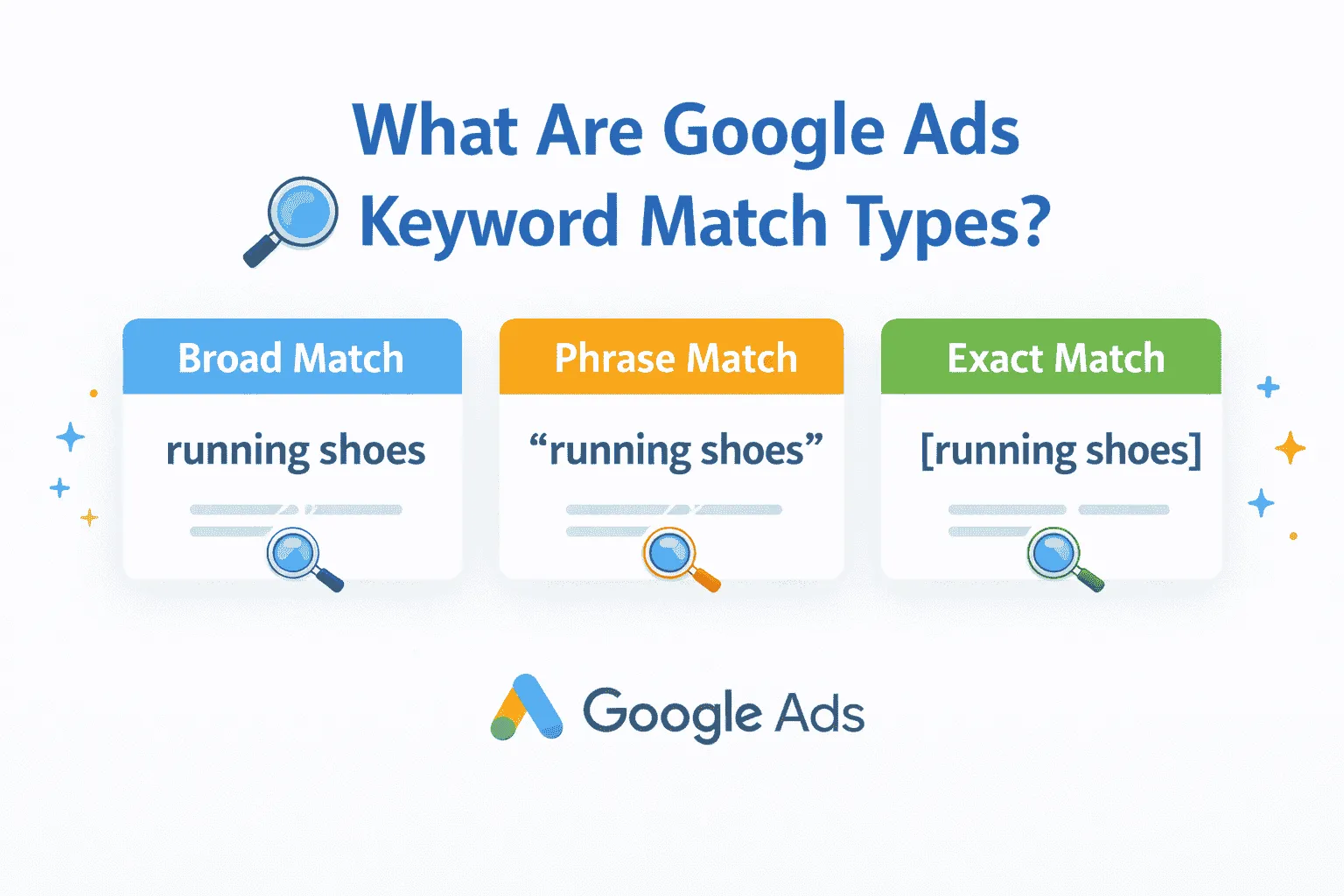
Keyword match types tell Google how closely a user’s search must match your keyword before your ad appears.
For example:
If your keyword is:
running shoes for men
Google will not always show your ad for every similar search. It depends on the match type you choose.
Match types help you:
-
Control who sees your ads
-
Reduce wasted budget
-
Get more relevant clicks
-
Improve conversions
-
Increase ROI
Without proper match types, your ads may show for irrelevant searches.
Why Keyword Match Types Are Important
Let us suppose that you are selling high-quality leather shoes.
If someone searches:
How to clean old shoes
And your advertisement lets us know that the clicking is in vain. You are spending money, and you are not even a customer.
Match types help you:
✔ Ads to the correct audience.
✔ Avoid irrelevant traffic
✔ Control ad spend
✔ Increase the rate of clicking (CTR)
✔ Increase conversion rate
That’s why understanding keyword match types is very important for Google Ads success.
The 3 Main Google Ads Keyword Match Types
Google Ads has three main keyword match types:
-
Broad Match
-
Phrase Match
-
Exact Match
Let’s explain each one in simple words with examples.
1️⃣ Broad Match
The default match type of Google Ads is broad match.
Google will automatically broad match in case you simply add a keyword, with no symbols.
Example Keyword:
- running shoes
Broad match: Your ad can be found in the results of searches like:
Buy sports shoes
jogging sneakers
best shoes for the gym
running gear
athletic footwear
Google displays your advertisement on related searches, even in the case, the specific words are not entered.
How Broad Match Works
Broad match uses:
- Synonyms
- Related searches
- Similar meanings
- User intent
Google attempts to know what the user desires.
Advantages of Broad Match
- More traffic
More impressions
Finds new keyword ideas
Good for testing - Shortcomings of Broad Match.
- Less control
Can waste budget
Invalid. May sustain irrelevant searches.
When to Use Broad Match
- Broad match is good when:
- You are interested in finding new search terms.
- You have a large budget
- You are the owner of Smart Bidding.
- You want maximum reach
Always, the negative keywords must have the broad match option to curtail waste.
2️⃣ Phrase Match
Phrase match is more controlling than broad match.
In order to use phrase match, you put your keyword in quotes.
Example:
“running shoes”
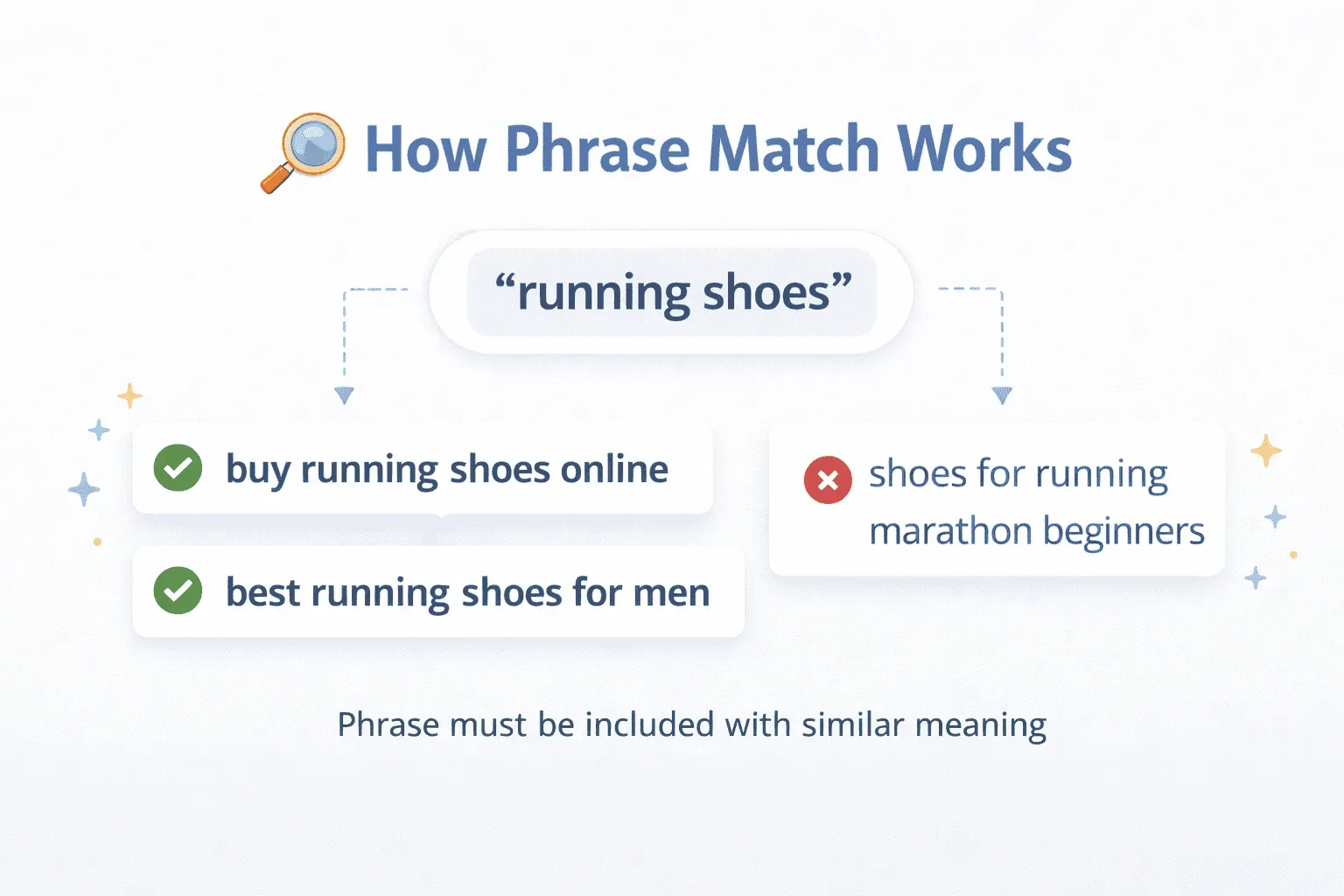
Your ad will now be displayed when the search includes such a phrase with a similar meaning.
- Your ad may show for:
- Buy running shoes online
- best running shoes for men
- running shoes near me
- affordable running shoes
- But it will NOT show for:
-
Shoes for running a marathon for beginners
(If meaning changes too much)
How Phrase Match Works
Phrase match allows:
-
Words before or after the phrase
-
Similar meaning searches
But the main phrase’s meaning must stay the same.
Advantages of Phrase Match
✔ Better control than broad
✔ More relevant traffic
✔ Adequate balance between reach and control.
✔ Higher conversion rate
Possible Disadvantages of Phrase Match.
Less reach than broad
Still can demonstrate in favor of certain undesired searches.
When to Use Phrase Match
Phrase match is best when:
-
You want balanced traffic
-
You want better targeting
-
You are scaling campaigns
-
You want quality leads
Most advertisers use phrase match for stable campaigns.
3️⃣ Exact Match
A strict match provides the highest level of control.
In order to use an exact match, enclose your keyword in square brackets.
Example:
[running shoes]
Now your advertisement will appear only when one is searching:
- running shoes
- running shoe
- running shoes (identical to the former)
Google allows close variants, but the intent must be the same.
Your ad may NOT show for:
-
Buy running shoes online
-
best running shoes for men
(If meaning changes too much)
How Exact Match Works
Exact match shows ads when:
- Search intent is the same
- Meaning is almost identical
- Close variants are allowed
Advantages of Exact Match
- Highest control
Highest relevance
Best conversion rate
Less wasted budget
Exact Match has its own shortcomings.
- Low traffic
Limited reach
Slower data collection
When to Use Exact Match
Exact match is best when:
You have your most converting keywords.
- You want high ROI
- You want to reduce waste
- You are maximizing the campaigns.
Many experts use exact matches for top-performing keywords.
Broad vs Phrase vs Exact (Simple Comparison)
| Feature | Broad Match | Phrase Match | Exact Match |
|---|---|---|---|
| Traffic Volume | High | Medium | Low |
| Control | Low | Medium | High |
| Budget Waste Risk | High | Medium | Low |
| Conversion Rate | Low-Medium | Medium-High | High |
| Best For | Testing | Scaling | Optimization |
Real-Life Example (Step-by-Step)
Let’s say you sell digital marketing courses.
Your keyword is:
digital marketing course
Broad Match:
digital marketing course
May show for:
-
online business classes
-
marketing training
-
SEO course
-
social media marketing tips
Phrase Match:
“digital marketing course”
May show for:
-
best digital marketing course
-
digital marketing course online
-
affordable digital marketing course
Exact Match:
[digital marketing course]
May show for:
-
digital marketing course
-
course for digital marketing
See the difference? “Broad” is wide, “phrase” is controlled, and “exact” is strict.
What Are Close Variants?
Google allows close variants in phrase and keyword match types in Google Ads.
Close variants include:
-
Singular or plural
-
Misspellings
-
Abbreviations
-
Same meaning words
Example:
Keyword: [car repair shop]
May show for:
-
car repair shops
-
auto repair shop
-
car repair near me
Google focuses more on user intent now.
What Are Negative Keywords?
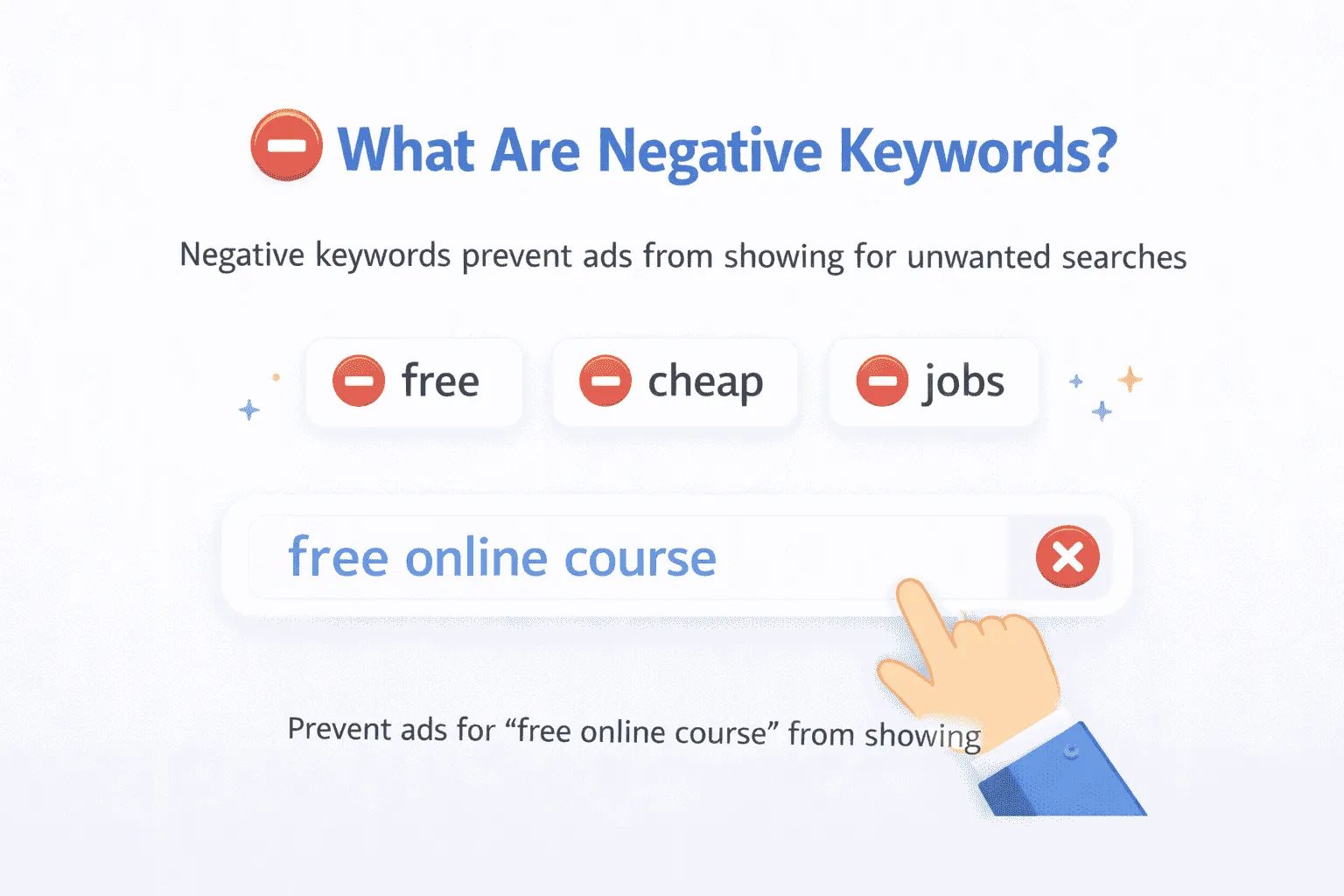
Negative keywords prevent your ads from showing for certain searches.
Example:
If you sell paid courses, add:
free
cheap
jobs
So your ad does not show for:
-
free digital marketing course
-
digital marketing jobs
Negative keywords are very important, especially with broad match.
Best Strategy for Using Match Types
Most experts use a combination strategy.
Smart Strategy:
-
Start with Phrase Match
-
Add Exact Match for high-performing keywords
-
Use Broad Match with Smart Bidding
-
Add Negative Keywords regularly
This strategy gives:
✔ Growth
✔ Control
✔ High ROI
Common Mistakes to Avoid
❌ Using Only Broad Match
Leads to wasted budget.
❌ Not Using Negative Keywords
Causes irrelevant clicks.
❌ Ignoring Search Term Report
Always check what users are searching.
❌ Using Too Many Exact Keywords in New Campaign
You may miss new opportunities.
Pro Tips for Better Results
✅ Check Search Terms Weekly
Remove irrelevant keywords.
✅ Use Smart Bidding with Broad Match
Google AI works better with data.
✅ Separate Campaigns by Match Type
For better control and testing.
✅ Increase Budget on Exact Keywords
They convert better.
✅ Track Conversions Properly
Without tracking, optimization is impossible.
How Google Match Types Have Changed Over Time
Earlier, match types were strict.
Now:
-
Phrase match is more flexible
-
Exact match allows close variants
-
Broad match uses AI
Google focuses more on search intent instead of exact words.
That’s why understanding intent is very important today.
Which Match Type Is Best?
There is no single best match type.
It depends on:
-
Your goal
-
Your budget
-
Your industry
-
Your competition
If You Want:
Maximum Traffic → Broad
Balanced Performance → Phrase
High ROI → Exact
Best practice is to use all three smartly.