

The Complete Guide to Finding the Right Keywords for SEO Success
Keyword research is one of the most important parts of search engine optimization (SEO). It helps content creators understand what users are searching for and how they search online. Without proper keyword research, even high-quality content may fail to reach the right audience. By selecting the correct keywords, websites can improve their visibility, attract targeted traffic, and achieve better search engine rankings.
What Is Keyword Research?

Keyword research is the process of finding and analyzing the words and phrases that people type into search engines when looking for information, products, or services. These words and phrases are called keywords.
The main goal of keyword research is to understand:
-
What your target audience is searching for
-
How often do they search for it
-
How competitive those keywords are
-
What kind of content satisfies their search intent
By targeting the right keywords, you can optimise your content to appear higher in search engine results pages (SERPs).
Why Is Keyword Research Important?
Keyword research is important because it connects your content with your audience. Below are some major reasons why keyword research is essential:
1. Improves Search Engine Rankings
Search engines rank content based on relevance. When you use the right keywords in your content, search engines understand what your page is about and rank it accordingly.
2. Drives Targeted Traffic
Keyword research helps attract users who are genuinely interested in your content. This means higher-quality traffic and better engagement.
3. Understands User Intent
Keyword research reveals why users are searching for something—whether they want information, want to buy something, or want to compare options.
4. Saves Time and Resources
Instead of guessing what to write, keyword research ensures that your content is aligned with real search demand.
5. Increases Conversions
Targeting the right keywords brings users who are more likely to convert into customers, subscribers, or leads.
Types of Keywords
Understanding different types of keywords is crucial for an effective keyword research strategy.
1. Short-Tail Keywords
Short-tail keywords consist of one or two words, such as:
-
SEO
-
Marketing
-
Blogging
These keywords have high search volume but are extremely competitive and less specific.
2. Long-Tail Keywords
Long-tail keywords contain three or more words, such as:
-
How to do keyword research for SEO
-
Best keyword research tools for beginners
They have lower search volume but higher conversion rates and less competition.
3. Informational Keywords
These keywords are used when users want information:
-
What is keyword research
-
How does SEO work
4. Navigational Keywords
Users use these keywords to find a specific website or brand:
-
Google Keyword Planner
-
Ahrefs login
5. Transactional Keywords
These keywords indicate buying intent:
-
Buy SEO tools
-
Best keyword research software price
6. Commercial Investigation Keywords
Users research before making a purchase:
-
Best keyword research tools
-
SEMrush vs Ahrefs
Short-Tail Keywords Explained in Detail
Short-tail keywords are search terms that usually contain one or two words. These keywords are very broad and general in nature.
Examples of Short-Tail Keywords
-
SEO
-
Blogging
-
Keyword research
-
Digital marketing
Characteristics of Short-Tail Keywords
-
Very high search volume
-
Extremely competitive
-
Broad search intent
-
Lower conversion rate
For example, a user searching for “SEO” may be a beginner, a student, a business owner, or just someone curious. The intent is unclear, which makes it difficult to satisfy the user completely.
Advantages of Short-Tail Keywords
-
Bring large amounts of traffic
-
Useful for brand awareness
-
Helpful for authoritative websites
Disadvantages of Short-Tail Keywords
-
Very difficult to rank for new websites
-
Low conversion rate
-
High competition
Short-tail keywords are best used by established websites with strong domain authority.
Long-Tail Keywords Explained in Detail
Long-tail keywords are phrases that contain three or more words. These keywords are more specific and targeted.
Examples of Long-Tail Keywords
-
How to do keyword research for SEO
-
Best keyword research tools for beginners
-
Long-tail keywords vs short-tail keywords
Characteristics of Long-Tail Keywords
-
Lower search volume
-
Low to medium competition
-
Clear search intent
-
Higher conversion rate
A user searching for “how to do keyword research for SEO” clearly wants step-by-step guidance, making it easier to provide relevant content.
Advantages of Long-Tail Keywords
-
Easier to rank
-
Higher conversion rate
-
Highly targeted traffic
-
Best for new and small websites
Disadvantages of Long-Tail Keywords
-
Lower traffic volume
-
Requires multiple keywords to scale traffic
Why Long-Tail Keywords Are Important
Long-tail keywords make up more than 70% of all online searches. They are especially important for blogs, niche websites, and affiliate marketing.
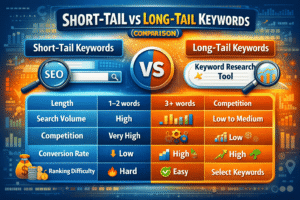
Short-Tail vs Long-Tail Keywords (Comparison)
| Feature | Short-Tail Keywords | Long-Tail Keywords |
|---|---|---|
| Length | 1–2 words | 3+ words |
| Search Volume | High | Low to Medium |
| Competition | Very High | Low |
| Conversion Rate | Low | High |
| Ranking Difficulty | Hard | Easy |
| Best For | Big websites | New websites |
Mid-Tail Keywords (Often Ignored but Very Important)
Mid-tail keywords fall between short-tail and long-tail keywords.
Examples
-
Keyword research tools
-
SEO keyword analysis
-
Content marketing strategy
Why Mid-Tail Keywords Matter
-
Balanced search volume
-
Moderate competition
-
Good conversion potential
Mid-tail keywords are ideal for websites that are growing and want consistent traffic.
LSI Keywords (Related Keywords) Explained
LSI (Latent Semantic Indexing) keywords are related terms that help search engines understand content context.
Examples for “Keyword Research”
-
SEO keywords
-
Search volume
-
Keyword difficulty
-
Search intent
-
Google Keyword Planner
Benefits of LSI Keywords
-
Improve content relevance
-
Prevent keyword stuffing
-
Help rank for multiple queries
Primary and Secondary Keywords
Primary Keyword
The main keyword you want your page to rank for.
Example: Keyword Research
Secondary Keywords
Supporting keywords related to the main topic.
Examples:
-
Keyword research tools
-
SEO keyword research
-
Long-tail keywords
Using both improves SEO and content quality.
Branded vs Non-Branded Keywords
Branded Keywords
Contain brand names.
Examples:
-
Ahrefs keyword research
-
SEMrush SEO tools
Non-Branded Keywords
Do not include brand names.
Examples:
-
Best keyword research tools
-
Free SEO tools
Both are useful depending on goals.
Geo-Targeted Keywords
These keywords include locations.
Examples
-
SEO services in Pakistan
-
Keyword research expert in Lahore
They are important for local SEO and service-based businesses.
Keyword Research Tools
Keyword research tools help marketers and content creators discover relevant keywords, analyze search volume, measure competition, and understand search trends. These tools provide valuable data that makes SEO and content planning more effective. By using keyword research tools, websites can target the right audience and improve their visibility on search engines. Different tools offer different features, so choosing the right one depends on experience level and marketing goals.
1. Google Keyword Planner
Google Keyword Planner is a free keyword research tool provided by Google. It is mainly designed for advertisers but is also useful for basic SEO research. The tool helps users discover new keyword ideas and shows estimated search volume and competition levels. Since the data comes directly from Google, it is considered reliable. It is especially useful for finding commercial and transactional keywords.
Key Points:
-
Free tool with a Google Ads account
-
Shows keyword search volume ranges
-
Displays competition level
-
Provides cost-per-click (CPC) data
-
Best for PPC and SEO basics
2. Ahrefs
Ahrefs is a powerful and advanced SEO tool widely used by professionals. It offers a large keyword database and provides detailed metrics to evaluate keyword difficulty. Ahrefs helps users understand how hard it is to rank for specific keywords. It also allows deep competitor analysis by showing which keywords competitors are ranking for. This makes it ideal for advanced SEO strategies.
Key Points:
-
Advanced keyword research features
-
Provides keyword difficulty (KD) score
-
Large and updated keyword database
-
Detailed SERP analysis
-
Strong competitor research tool
3. SEMrush
SEMrush is an all-in-one digital marketing and SEO platform. It provides comprehensive keyword research tools along with content and competitor analysis features. One of its strongest features is keyword gap analysis, which helps identify missing keyword opportunities. SEMrush also categorizes keywords based on search intent, making content planning easier. It is widely used by agencies and professional marketers.
Key Points:
-
All-in-one SEO and marketing tool
-
Keyword gap analysis feature
-
Search intent classification
-
Competitor keyword research
-
Content optimization suggestions
4. Ubersuggest
Ubersuggest is a simple and beginner-friendly keyword research tool. It is designed for bloggers, students, and small business owners. The tool provides keyword ideas, search volume, and SEO difficulty in an easy-to-understand format. Ubersuggest is more affordable compared to other premium tools. It is a good choice for users who are new to SEO.
Key Points:
-
Easy-to-use interface
-
Provides keyword ideas and suggestions
-
Shows search volume and SEO difficulty
-
Affordable pricing plans
-
Suitable for beginners
5. Moz Keyword Explorer
Moz Keyword Explorer is a trusted SEO tool that focuses on keyword quality and relevance. It provides metrics such as keyword difficulty and opportunity score. The tool helps users prioritize keywords that have better ranking potential. Moz also offers SERP analysis to understand current ranking pages. It is useful for strategic and long-term SEO planning.
Key Points:
-
Keyword difficulty and opportunity scores
-
Helps prioritize valuable keywords
-
Detailed SERP analysis
-
Focus on keyword relevance
-
Reliable SEO data
6. Google Search Console
Google Search Console is a free tool that helps website owners monitor search performance. It shows actual keywords that users type to find a website. The tool provides data on impressions, clicks, and average position. Google Search Console is extremely useful for optimizing existing content. It plays an important role in ongoing SEO improvement.
Key Points:
-
Free tool by Google
-
Shows real search queries
-
Displays clicks, impressions, and CTR
-
Helps optimize existing pages
-
Tracks keyword performance
Step-by-Step Keyword Research Process
Step 1: Identify Your Niche and Goals
The first step in keyword research is to clearly identify your niche and define your goals. Understanding your target audience helps you choose keywords that match their needs and interests. You must also understand your industry and the type of content you want to create. Your goals may include educating users, increasing sales, building brand awareness, or driving website traffic. Clear goals make keyword selection more focused and effective.
Key Points:
-
Identify your target audience
-
Understand your industry or niche
-
Define content purpose (education, sales, branding)
-
Set clear SEO and marketing goals
-
Align keywords with user needs
Step 2: Brainstorm Seed Keywords
Seed keywords are the basic foundation of keyword research. These are simple and broad terms directly related to your main topic. Brainstorming seed keywords helps you understand the core ideas of your content. These keywords are later expanded into more specific keyword phrases. Seed keywords act as a starting point for discovering hundreds of related keywords.
Key Points:
-
Basic and broad keywords
-
Directly related to your topic
-
Used as a starting point
-
Help generate keyword ideas
-
Easy to identify
Examples:
-
Keyword research
-
SEO keywords
-
Search engine optimization
Step 3: Expand Keyword Ideas
After identifying seed keywords, the next step is to expand them into more specific keyword ideas. This step helps uncover long-tail and related keywords that users actually search for. Expanding keyword ideas increases content visibility and ranking opportunities. Using multiple sources ensures a wider range of keyword options. This step is important for finding low-competition keywords.
Key Points:
-
Use keyword research tools
-
Use Google autocomplete suggestions
-
Check “People Also Ask” section
-
Analyze related searches
-
Focus on long-tail keywords
Step 4: Analyze Search Volume
Search volume analysis helps determine how often a keyword is searched in a specific period. Choosing keywords with sufficient search volume ensures that your content has traffic potential. Keywords with very low search volume may not bring meaningful traffic. However, balance is important, as high-volume keywords are often highly competitive. This step helps prioritize keywords wisely.
Key Points:
-
Check monthly search volume
-
Avoid keywords with zero searches
-
Balance volume and competition
-
Use reliable keyword tools
-
Focus on realistic traffic potential
Step 5: Evaluate Keyword Difficulty
Keyword difficulty measures how hard it is to rank for a specific keyword. High difficulty keywords usually have strong competition from authoritative websites. New or small websites should avoid highly competitive keywords. Choosing low to medium difficulty keywords increases ranking chances. This step helps save time and effort in SEO.
Key Points:
-
Analyze keyword competition
-
Check keyword difficulty score
-
Avoid highly competitive keywords
-
Focus on low to medium difficulty
-
Best for new websites
Step 6: Analyze Competitors
Competitor analysis helps you understand what is already working in your niche. By analyzing competitor keywords, you can identify opportunities that they are ranking for. This step helps discover content gaps and missing keywords. Learning from competitors improves your own keyword strategy. It also helps you avoid unnecessary mistakes.
Key Points:
-
Identify main competitors
-
Check competitor ranking keywords
-
Find keyword gaps
-
Analyze competitor content
-
Improve keyword strategy
Step 7: Understand Search Intent
Search intent explains why a user searches for a particular keyword. Understanding search intent ensures your content matches user expectations. Keywords may have informational, navigational, commercial, or transactional intent. Content that matches search intent ranks better and performs well. Ignoring search intent can reduce rankings and engagement.
Key Points:
-
Identify user purpose
-
Match content with intent
-
Improve user satisfaction
-
Increase ranking chances
-
Reduce bounce rate
Step 8: Select Primary and Secondary Keywords
The final step is selecting primary and secondary keywords. The primary keyword is the main focus of your content. Secondary keywords support the main keyword and add relevance. Using both types creates natural and SEO-friendly content. This step helps avoid keyword stuffing and improves content structure.
Key Points:
-
Choose one primary keyword
-
Select multiple secondary keywords
-
Maintain keyword relevance
-
Improve content structure
-
Support SEO optimization
Keyword Research for SEO
Keyword research plays a central role in SEO strategy.
On-Page SEO
Use keywords in:
-
Title tag
-
Meta description
-
Headings (H1, H2, H3)
-
URL
-
Content body
Off-Page SEO
Keywords help in anchor text optimization and link-building strategies.
Technical SEO
Keyword research supports site architecture and internal linking.
Keyword Mapping
Keyword mapping is the process of assigning keywords to specific pages on your website. This avoids keyword cannibalization and improves SEO structure.
Common Keyword Research Mistakes

1. Targeting Only High-Volume Keywords
High volume does not always mean high value.
2. Ignoring Search Intent
Content that does not match intent will not rank.
3. Keyword Stuffing
Overusing keywords can lead to penalties.
4. Not Updating Keyword Strategy
Search trends change over time.
5. Ignoring Long-Tail Keywords
Long-tail keywords are easier to rank and convert better.
Best Practices for Keyword Research
-
Focus on relevance over volume
-
Use a mix of short-tail and long-tail keywords
-
Analyze competitors regularly
-
Update keywords based on trends
-
Track keyword performance
Keyword Research for Content Marketing
Keyword research helps content creators:
-
Generate blog ideas
-
Create user-focused content
-
Improve engagement
-
Build topical authority
Keyword Research for Paid Advertising
In PPC campaigns, keyword research helps reduce costs and improve ad targeting by selecting high-intent keywords.
Future of Keyword Research
With AI, voice search, and semantic search, keyword research is evolving. Focus is shifting from exact-match keywords to:
-
Topic clusters
-
Search intent
-
Natural language queries
Conclusion
Keyword research is not just an SEO technique; it is a strategic process that connects your content with your audience. By understanding what people search for, how they search, and why they search, you can create content that ranks higher, attracts quality traffic, and achieves real results.
Whether you are a beginner or an experienced marketer, mastering keyword research is essential for long-term success in digital marketing. When done correctly, keyword research becomes the backbone of a powerful and sustainable SEO strategy.